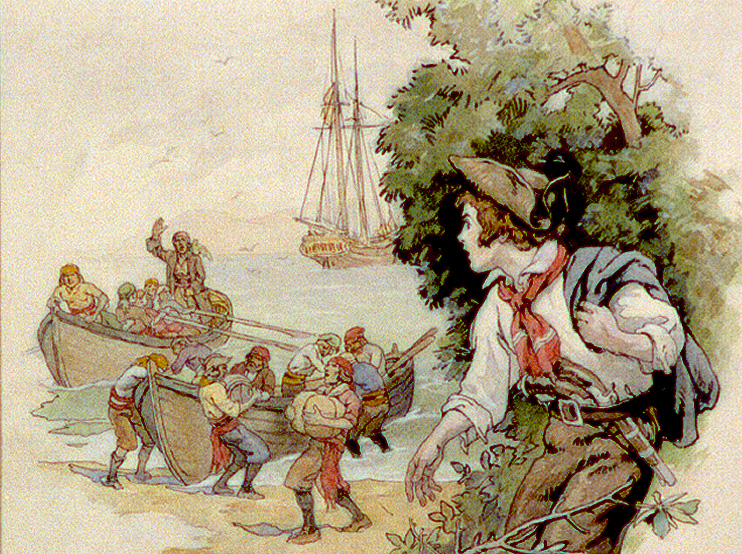
 Stevenson is most often associated with his swashbuckling Treasure Island or the macabre Dr. Jekyll and Mr. Hyde. But he spent a considerable time in the United States and I've been reading Across the Plains, his account of his first traverse of the country by rail. Stevenson had a bit of Jekyll/Hyde in his own life, for though he came from an upper-middle class Scottish family which afforded him considerable income, he did like to slum, and may have had to do so on this particular occasion, because his first journey to America in 1879 was taken without the knowledge of his parents, in order to reach Mrs. Fanny Osbourne, an unhappily married woman he had fallen in love with, living then in California. Crossing the Atlantic, and then taking a ferry from New York to Jersey City, Stevenson found himself packed together with a mob of other new arrivals, who once on shore commenced "a stampede" for the train station. "People pushed and elbowed, and ran, the families following how they could. Children fell, and were picked up to be rewarded by a blow. One child, who had lost her parents, screamed steadily and with increasing shrillness, as though verging towards a fit...I was so weary that I had twice to make a halt and set down my bundles in the hundred yards or so between the pier and the railway station, so that I was quite wet by the time that I got under cover." He then traveled, by one train or another, as far west as the Missouri River. There, he was herded aboard what was known as an emigrant train. No Pullman Palace cars or other luxuries for this lot! "A white-haired official, with a stick under one arm, and a list in the other hand, stood apart in front of us, and called name after name in the tone of a command. At each name you would see a family gather up its brats and bundles and run for the hindmost of the three cars that stood awaiting us, and I soon concluded that this was to be set apart for the women and children. The second or central car, it turned out, was devoted to men travelling alone, and the third to the Chinese." Stevenson, with the other solo travelers, found himself in a "long, narrow wooden box, like a flat-roofed Noah's ark, with a stove and a convenience [bathroom], one at either end, a passage down the middle, and transverse benches upon either hand. Those [trains] destined for emigrants on the Union Pacific are only remarkable for their extreme plainness, nothing but wood entering in any part into their constitution, and for the usual inefficacy of the lamps, which often went out and shed but a dying glimmer even while they burned. 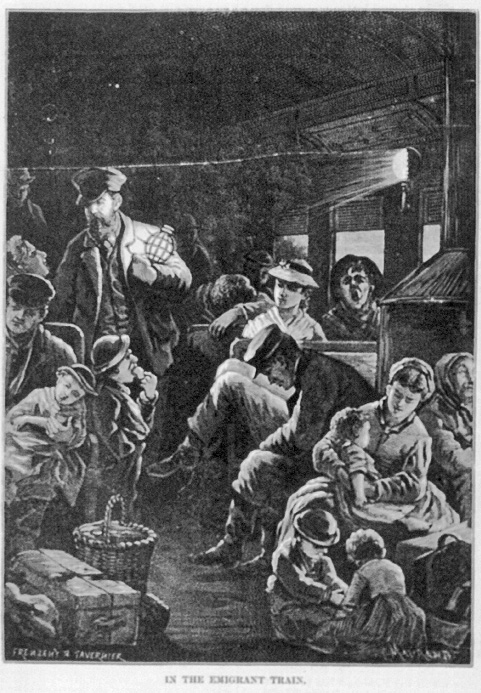 "The benches are too short for anything but a young child. Where there is scarce elbow-room for two to sit, there will not be space enough for one to lie. Hence the company [has]...conceived a plan for the better accommodation of travellers. They prevail on every two to chum together. To each of the chums they sell a board and three square cushions stuffed with straw, and covered with thin cotton. The benches can be made to face each other in pairs, for the backs are reversible. On the approach of night the boards are laid from bench to bench, making a couch wide enough for two, and long enough for a man of the middle height; and the chums lie down side by side upon the cushions with the head to the conductor's van and the feet to the engine. When the train is full, of course this plan is impossible, for there must not be more than one to every bench, neither can it be carried out unless the chums agree. It was to bring about this last condition that our white-haired official now bestirred himself. He made a most active master of ceremonies, introducing likely couples, and even guaranteeing the amiability and honesty of each. The greater the number of happy couples the better for his pocket, for it was he who sold the raw material of the beds. his price for one board and three straw cushions began with two dollars and a half; but before the train left, and, I am sorry to say, long after I had purchased mine, it had fallen to one dollar and a half."
Stevenson's trip is definitely worth a read. Unlike quite a few other train travelogues of this era, he describes conditions of travel for poor folk. The full text can be found on Google Books.
0 Comments
Your comment will be posted after it is approved.
Leave a Reply. |
James West Davidson
Occasional thoughts on history, teaching, paddling and the outdoors Archives
May 2019
Categories
|
 RSS Feed